

How we lost hope and why it matters
Why the past fifteen years have left millennials and their successors without anchors - and how what we can salvage for our collective future.
By Bertrand de Volontat
The world no longer feels like a promise. For millennials and subsequent generations, the past fifteen years have been marked less by optimism than by a succession of crises—economic, political, ecological, health-related, and existential. This is what Max Weber called the disenchantment of the world: no longer believing that tomorrow will deliver more, but wondering what deprivations it will bring. This essay asks a simple yet difficult question: how, then, can we (re)invent stories to inspire progress?
Retreating into pessimism
For fifteen years now, we have lived in a world where the future presents itself not as a promise but as a concern. Financial crises, the pandemic, climate collapse, wars in Europe, inflation, digital loneliness, democratic fatigue: so many shocks that, taken together, have eroded the joyful optimism of the early 2000s. Fifteen years where every hope met a setback. Fifteen years that have transformed the very idea of the future, shifting it from the realm of promise to that of anxiety.
It is not only an accumulation of crises, but an atmosphere. A time when optimism seems naïve, and where glass ceilings and glass walls are closing in, constricting the future and frustrating every attempt to find a fissure or crack to let us through. I see this as a millennial but I look back and understand that the generations coming behind must feel it even more acutely.
Nicolas Qui Paie - a modern Tantalus
A generation ago, the future presented itself if not always as an escalator at least as a ladder heading towards a better world: work hard, buy a house, live better than your parents, benefit from the wonders of innovations and new technologies. Today, those promises are broken. Work pays much less: stagnant wages, precarious contracts, dwindling recognition. Housing has become inaccessible without the support of wealthy parents. Owning a property - a common and lucrative prospect for boomers of any class - has become a rare privilege. Innovation, once a collective horizon is now more spectacle than shared uplift.
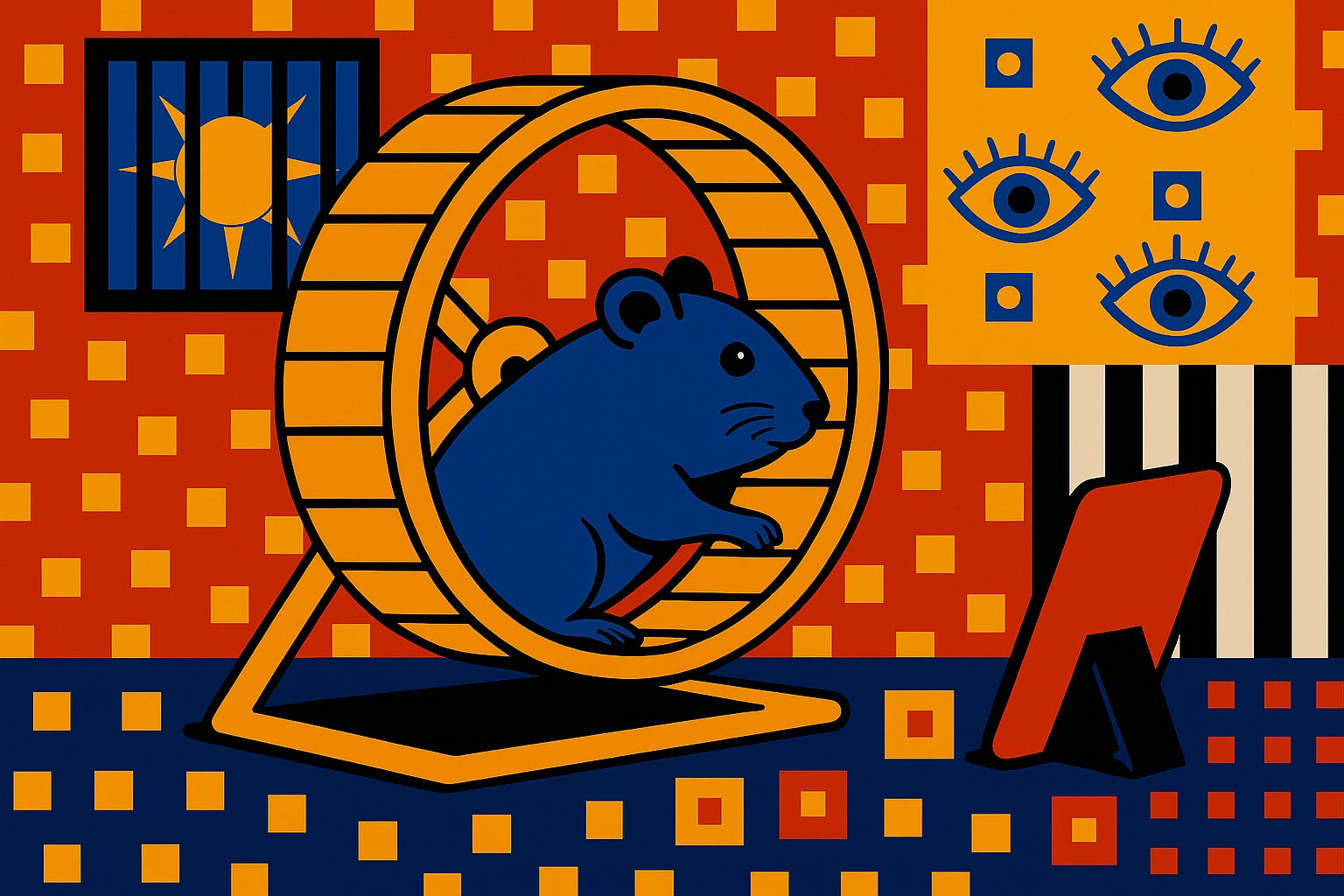
The phenomenon is incarnated in “Nicolas Qui Paie”, a 30-year-old French executive who works, pays his taxes, but will never have the retirement or wealth of his parents. He watches the boomers enjoy themselves, the ultra-rich take off, and realises he is condemned to run without ever catching up. It is a parable of millennial disenchantment, a modern day Tantalus, condemned to strive eternally without ever receiving the fruits of his labour. This mismatch between effort and expected reward fuels a broad spectrum of resentment, magnified by the rise of social media. We can see the better life in our feeds, but we cannot touch it in our reality.
From disenchantment to anaesthesia
Nietzsche foresaw this era of nihilism: the moment when great narratives collapse, when the future ceases to be a promise and becomes a worry. We are there. Every truth has its opposite, every narrative its own inversion. Everything circulates at the speed of the scroll, everything burns out within 24 hours. We live saturated with information, but impoverished of meaning, often caught in the imagination of others, which harms our own lives.
Digital culture illustrates this drift to the extreme. In Bloomberg Businessweek, Amanda Mull describes how the algorithmic machine of social media produces trends even stranger and more incomprehensible: Labubu, Dubai Chocolate, Sonny Angel, Crumbl cookie… A list that looks less like a culture than a stream of absurd signals, made to capture a few seconds of attention before disappearing.
“The Social Media Trend Machine Is Spitting Out Weirder and Weirder Results,” she writes. These micro-trends have no story, no link to practices, no roots in collective experience: they exist because they circulate, and they circulate because they exist.
This is exactly what Nietzsche glimpsed in nihilism: a saturation of stories without horizons, of stimuli without meaning. We do not lack stories. We lack stories that endure, that guide, that gather. Where once a generation could be united around a common horizon, today we have fleeting signals designed only to hold our attention for a few seconds.
And, faced with this emptiness, the collective imagination is saturated with two types of narratives: those that numb, and those that capture and manipulate.
The narrative that numbs
Le Monde Diplomatique illustrates in its analysis of the daily soap opera Un Si Grand Soleil. Though there are a million equally apposite examples. Behind its apparent neutrality, the series depoliticises everything: every conflict reduced to a private intrigue, every tension resolved without collective consequence. Above all, the narration loops endlessly, reproducing the same present, like a soft Matrix, where everything seems realistic—the settings, accents, concerns—but it is a fake realism. An ordinary life where “everything is fine” despite the crises.
This intermingling of the fake and the real is designed to manufacture the illusion that reality is bearable - the blue pill. The viewer believes they are seeing a reflection of their daily life, when in fact they are offered a sanitised version: reassuring, without conflict, without transformation. It is silent brainwashing, a televisual antidepressant that is anything but neutral. It is an infernal spiral, a narrative that evacuates real disenchantment by constructing an artificial normality, and therefore a political tool.
The narrative that captures
At the other extreme, other narratives are designed to “awaken,” or perhaps more accurately trigger. Reimagined history can be particularly co-opted to this approach, feeding off nostalgia and a sense of familiarity and connection. As Le Monde reports, the populist right has been particularly effective at deploying this technique. Once again, the collective is manipulated: a mythologized past projected as a future, to give direction to those unsettled by the void.
This cognitive and emotional manipulation is practised at different levels, without anything genuinely new ever being proposed. As Giuliano da Empoli identifies in The Hour of the Predators, populism thrives by marrying fear and anger, upgraded by algorithms.
“The people, very close to their reptilian brain, are subject to their negative impulses, and it is therefore simple, especially with fake news, to manipulate them in this direction.”
Here, nihilism takes on a very concrete form: the future is no longer a promise, but a threat. Politics no longer projects towards what could be, but exploits what is most archaic in us: fear, resentment, retreat.
Instead of living in utopia, we live in nostalgia and doubt. Ted Gioia calls it “dopamine culture”: an online life designed to stimulate, not to nourish. Not the rise of culture, but the engineering of compulsion. Again, movement without horizon.
The obliteration of optimism
These seeds are nourished by fertile soil. Ezra Klein, in Abundance, presses this point:
“We have lost faith in the future that once fuelled our optimism.”
We no longer argue about what is coming, but about what we still possess, or what we have lost. He highlights a striking historical contrast:
Between 1875 and 1905, the Western world saw the emergence of electricity, the automobile, the aeroplane, cinema, photography, the phonograph, skyscrapers. Each generation experienced radical transformations, as in the 1960s with the advent of early new technologies. Between 1990 and 2020, we mostly perfected the digital, concentrated in a single object: the smartphone. Brilliant, alongside social media, but keeping us in inertia. And the disruption of AI today brings, at this stage, more uncertainty than hope.
Even AI, ultimately—sold as the great rupture of our time—is already starting to normalise. David Wallace-Wells reminded us in the NYT: behind the hype, GPT-5 is welcomed as an ordinary tool, useful of course, but far from technological utopia. This may be the strongest sign of our era: even our revolutions look like incremental updates.
Inventing new narratives
Fortunately, Nietzsche invites us to see this crisis not as an end, but as a threshold. A painful but fertile passage: the chance to create something new, to formulate values and narratives that do not yet exist. Faced with the void, two temptations dominate: to take refuge in cynicism or anesthesia; to give into simplistic, identity-based stories that capture our need for meaning.
The only alternative—the hardest but the most fruitful—is Nietzschean: to create. To invent narratives that do not neutralise, that do not capture, but that open.
If I reflect on all this, it is also as a media professional, immersed daily in this battle of attention and narratives. The media are caught in this noise. Torn between the temptation of the anesthetising flow, the caricature that confines, the hijacked or manipulated stories, the mimicry that feeds fatigue. The media bear the responsibility of creating meaning where all the signals reward repetition. In this context, the decline of Search, which fostered a reactive approach to respond to trends rather than inspire them, is a unique opportunity for reinvention.
Media and creators (and the entire cultural world) therefore play an essential role: newsrooms reinventing their formats, independents (newsletters, YouTube channels, Substack) exploring niches, giving voice to communities, producing real added value, journalists choosing to slow down, to give meaning, to create stories that open rather than repeat.
This is the core of my own personal commitment: to help this quality journalism emerge, circulate, reach people—even amid the noise—and to generate the revenues indispensable to its survival and to stimulate new growth.
Artificial intelligence can also contribute positively to this future: nurturing new creativity, giving journalism an amplified capacity for storytelling, or on the contrary, amplifying noise and disinformation. AI can enhance investigative power, reinvent access to archives, create new formats. All this is already being tested or is live in some places.
Disenchantment must no longer be a fatality. It must be, as Nietzsche saw it, the threshold of a new beginning. But it will only open if we accept to create, to invent narratives that once again make the future a promise.
This article was originally published in French on Bertrand De Volontat’s Medium
Bertrand de Volontat is a media strategist and journalist with over 15 years of experience at the intersection of content, technology, and business. He is currently VP of Publishers & EMEA at Nordot, where he leads global partnerships, content marketing, and growth initiatives to help publishers expand their reach and revenue across borders. Beyond his role, he often reflects on the broader shifts shaping media, storytelling, and the future of journalism.